
The Sign on the Inn
Waking Up to the Ashes of 2026
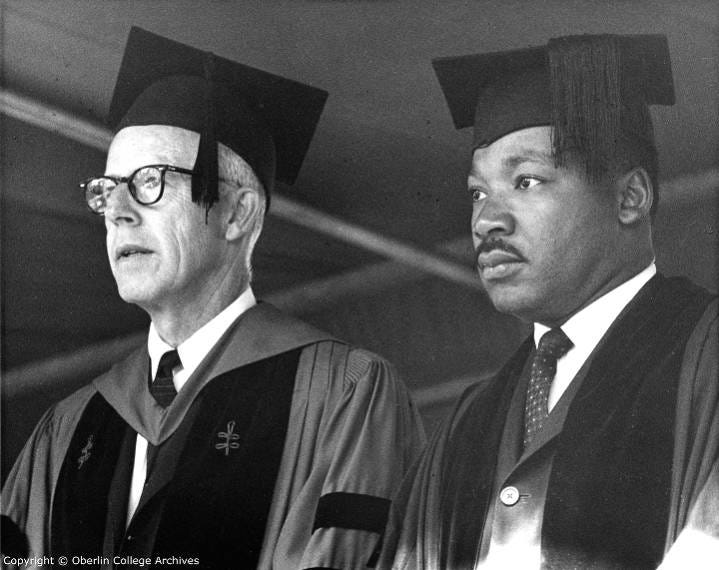
In June 1965, the Reverend Dr. Martin Luther King, Jr. stood before the graduating class of Oberlin College and retold the story of Rip Van Winkle. We all know the headline: the man slept for twenty years. But Dr. King pointed out a detail almost everyone misses. When Rip went up the mountain, the sign on the village inn bore the face of King George III of England. When he came down, the sign bore the face of George Washington.
The tragedy of Rip Van Winkle was not that he slept; it was that he slept through a revolution. He missed the moment the world shifted from tyranny to self-governance.
Tomorrow is Martin Luther King Jr. Day. As we stand in this precarious moment of January 2026, we are haunted by the inverse of King’s warning. If Rip Van Winkle were to fall asleep today and wake up twenty years from now, whose face would be on the sign? Would it be the face of a democratic republic, or would it be the face of a man who names the roads after himself while the world burns?
By juxtaposing Dr. King’s timeless philosophy with the terrifying events of the last three weeks—from the invasion of Venezuela on January 3rd to the absurd spectacle at Mar-a-Lago this past weekend—we are forced to confront a grim reality. We are not merely sleeping through a revolution; we are sleepwalking into a violent devolution.
The Spectacle Over the Slaughter: The Mar-a-Lago Road Naming
Dr. King warned the students of Oberlin against becoming “detached spectators.” He urged them to remain awake during times of social transformation. Today, remaining awake is harder than ever because the anesthesia has changed. It is no longer just ignorance; it is the “spectacle.”
Consider the timeline we are living through.
On January 3, 2026, the United States military initiated an invasion of Venezuela. As noted by analysts at Brookings and other observers, this operation has plunged the region into chaos. Yet, just two weeks later, while American troops are on the ground and the geopolitical fallout is spiraling, where was the Commander-in-Chief?
He was not in the Situation Room. He was not addressing the nation on the “clamorous highways of life” King described.
According to reports surfacing yesterday, President Trump cut short official White House business to fly to South Florida for a ceremony naming a road after himself. While the smoke still clears over Caracas, the President stood on a stage near Mar-a-Lago this weekend, engaging in behavior that conservative commentator George Will described as a “presidency unraveling in real time.”
In a scene that blurred the lines between governance and reality television, the President boasted about poll numbers that do not match reality and bragged about “billions of dollars moving through international channels” and foreign bank accounts as if they were personal savings. But the spectacle descended into something darker when he turned his attention to advisor Laura Loomer. In a moment described as “awkward and revealing,” he oscillated between flirting with her, insulting her, and physically grabbing her on stage—a grotesque display of the “I-it” relationship Dr. King warned against, where human beings are reduced to objects for the powerful to use.
Most alarmingly, the President openly declared to the cheering crowd that he “doesn’t need lawyers,” doesn’t consult oversight, and is guided only by his own morality. This was not a policy speech; it was a declaration of impunity.
The War Comes Home: Uninvited and Unchecked
While the President enjoys the adulation of the crowd in Florida, mocking the very concept of legal restraint, the consequences of that lawlessness are playing out in the streets of America. Dr. King’s Oberlin address focused heavily on the need for “civil rights” and the eradication of police brutality. He dreamed of a nation where justice “rolls down like waters.”
Instead, in 2026, we are seeing armored vehicles rolling down the streets of American cities—uninvited by mayors, unwanted by governors, and unchecked by Congress.
In the shadow of the Venezuela operation, we have seen a simultaneous, militarized crackdown within our own borders. ICE agents, bolstered by military support, have been deployed into sovereign US cities to conduct raids that have resulted in the deaths of innocent people. These are not statistics; these are the “children of God” King spoke of.
King warned that “violence ends up creating many more social problems than it solves.” When the state turns its weapons on its own people, bypassing local laws and due process, we have crossed the threshold from democracy to occupation. The President’s declaration this weekend that he acts “without legal review” is not just rhetoric; it is the operational doctrine that led to the deaths of civilians in our own neighborhoods this month.
Burning Down the “World House”
Dr. King spoke eloquently of the “World House,” the inescapable reality that “we have inherited a big house... in which we have to live together.” He argued that “no individual can live alone; no nation can live alone.”
The events of January 2026 represent an arsonist running loose in that World House. The invasion of Venezuela was only the spark. With reports now circulating of potential U.S. military actions targeting Greenland—a dispute that began as a bizarre purchase offer and has mutated into imperial aggression—along with escalating threats toward Iran and Cuba, we are witnessing a foreign policy defined by impulse and ego.
King warned that we must “find some alternative to war and bloodshed.” Instead, we are finding excuses for it. The isolationist arrogance on display in Florida—where the President bragged about accepting massive oil shipments and foreign money while dismissing the counsel of his own government—is the behavior of a leader who believes he is landlord of the World House, with the power to evict whole nations at will.
The Myth of Time is Dead
One of King’s most piercing arguments at Oberlin was the rejection of the “myth of time.” He dismantled the idea that time is neutral or that “it will work itself out.” He told the graduates: “Time... can be used either constructively or destructively. And I’m absolutely convinced that the people of ill will in our nation... have used time much more effectively than the people of good will.”
Look at Washington today. The “private panic” among Republican leadership described in recent reports is the result of believing the myth of time. They waited. They held “tense conversations that never reached microphones” while the invasion plans for Venezuela were drawn up. They waited while the troops were sent to Chicago and New York. They are still waiting, hoping that the “spectacle” at Mar-a-Lago—the road naming, the insults, the chaos—is just harmless entertainment.
King tells us from the grave: Time fixes nothing. The invasion of Venezuela did not happen overnight; it happened because we waited. The innocent lives lost to ICE agents were not accidents; they were the cost of our silence.
The Choice: Silent Onlookers or Involved Participants
So, what demands does MLK make of us on this day?
The Oberlin address gives us our marching orders. King implored the students: “Never allow it to be said that you are silent onlookers, detached spectators, but that you are involved participants in the struggle to make justice a reality.”
We can no longer afford to be onlookers. The “struggle” is no longer abstract history. It is in the streets of Caracas, the coastal waters of Greenland, and the neighborhoods of our own cities.
Reject the Spectacle: We must look past the distraction of the road-naming ceremony. The President’s vanity is not the story; the body count in Venezuela and the US is the story. We must see the “no lawyers” comment for what it is: a confession of autocracy.
Defend the “World House”: We must vocally oppose the reckless expansion of conflict into Iran, Cuba, and the Arctic. We must demand that the U.S. return to the “positive affirmation of peace” rather than the “negative expulsion of war.”
Protect the Innocent at Home: We must demand the immediate withdrawal of uninvited federal troops and ICE agents from our cities. The “security of the academic environment” King spoke of is gone; we are all on the “clamorous highways” now, and we must stand in the path of the injustice.
When Rip Van Winkle came down the mountain, the revolution had already happened. He was lost because he had slept. We do not have the luxury of sleep. The sign on the inn is being painted over right now. It is up to us—through the “coalition of conscience” King called for—to ensure that we do not wake up twenty years from now to a world where the sign reads “Tyranny.”
We must remain awake. We must stop Trump. We must save the house…our house…the world’s house.